
Understanding diode lasers: how permanent hair reduction works
Hair growth, light and heat, three wavelengths and professional procedures: an in-depth article from the AweneX specialist manual on the ATWX 2400.
KNOWLEDGE & APPLICATIONS · DIODE LASERS
A diode laser turns light into targeted heat. For this to result in successful hair reduction, several factors need to work together: the hair as the target structure, the condition of the skin, the device settings and skilled application. Understanding these relationships makes it easier to assess the technology’s potential and provide clients with clearer advice.
Our specialist guide to the ATWX 2400 therefore combines information about the device with hair biology, treatment planning and aftercare. This article covers the key fundamentals. It is for beauty professionals who want to deepen their understanding and for anyone interested in learning what lies behind a professional laser treatment.
1. hair and skin: the basis of the treatment
What we see above the skin is the hair shaft. The structures from which a hair grows lie deeper in the skin: in the hair follicle. This distinction is crucial for laser treatment. Shaving shortens the visible hair; light-based treatment targets pigmented hair structures within the follicle and its surrounding area.
A central role is played by Melanin. This pigment, which occurs naturally in the body, influences hair and skin colour, among other things. Pigmented hair absorbs some of the laser energy emitted. This is why hair colour and thickness are important factors when assessing a treatment.
Dark, coarse hair generally provides a more favourable target than very light, white or grey hair. Red and very fine hair may also respond only to a limited extent. High device output cannot compensate for a lack of hair pigment. Honest advice explains this limitation before the first appointment.
Melanin is also present in the skin. The skin’s surface can therefore also absorb light energy. Natural skin tone, recent tanning and the skin’s current condition are all part of the professional assessment. The Fitzpatrick scale provides guidance but does not replace an individual assessment. Whether a person may be treated and which approach is suitable must be determined in accordance with the applicable requirements and the approved use of the device.
2. Why multiple appointments are necessary
Hair grows in cycles. The follicles in a body area are not all in the same phase at the same time. This explains why a single session cannot reach all existing hairs with the same effectiveness.
| Phase | What’s happening? | Why is this relevant? |
|---|---|---|
| Anagen phase Growth phase |
The hair is actively growing and connected to the growth-active structures of the follicle. | Pigmented hairs are particularly accessible to light-based treatment during this phase. |
| Catagen phase Transition phase |
The active growth phase ends; the follicle changes. | The conditions for targeted treatment also change. |
| Telogen phase Rest period |
The follicle is in a resting phase before a new cycle begins. | A new hair may become visible later. Another appointment may then be advisable. |
A course of treatment takes this staggered growth into account. At later appointments, hairs that have since entered a more favourable phase are targeted. Visible regrowth after one session therefore does not automatically mean that the treatment has been ineffective.
The intervals between appointments should match actual hair growth and the skin’s response. Body areas differ, and the appropriate interval may change as hair reduction progresses. A fixed schedule is therefore less informative than a clear, individually tailored plan.
3. How light creates an effect in the hair follicle
The basic principle is selective photothermolysis. Put simply, light is absorbed by a suitable target structure and converted into heat. In hair reduction, the melanin in pigmented hair structures is a key light absorber.
The heat generated can thermally affect follicle structures relevant to growth and thereby reduce subsequent hair growth. The aim is to heat the intended structures effectively while placing as little stress as possible on the surrounding skin.
This selectivity is not an automatic guarantee. Wavelength, energy output, pulse duration, hair profile and skin condition affect where and how much heat is generated. Cooling and application technique also contribute to the overall process. Proper professional adjustment of these factors is therefore central to professional laser work.
Laser and IPL both use light, but differ in their light source. A laser system emits light within defined wavelength ranges. IPL uses a broader, filtered light spectrum. The terms are therefore not interchangeable, and the properties of a specific system should always be assessed using its own documentation.
4. What the three wavelengths mean
In the device profile of the technical manual, the ATWX 2400 with 750, 808 and 1064 nm described. Nanometres, abbreviated as nm, are the unit of wavelength. They indicate a property of the emitted light.
Different wavelengths are absorbed and scattered differently by skin and hair structures. This also means that the energy can be distributed differently in the tissue. A blanket equation such as “longer wavelength equals better results” is therefore an oversimplification.
With a system featuring multiple wavelengths, the specific handpiece design is decisive. The presence of multiple wavelengths alone does not indicate whether they can be selected individually, in what proportions they are delivered, or which setting is suitable for a person.
A wavelength specification also does not automatically describe the type of laser. A diode system with a particular wavelength does not thereby become a different laser system with another light source. The approved configuration and the documented properties of the specific device are what count for the assessment.
Multiple wavelengths extend a technical concept. Whether this offers an advantage for a particular application must be considered in relation to the hair, skin, device and operation.
5. power, fluence and pulse duration explained clearly
Device displays show various values side by side. They describe different aspects of a light pulse. Understanding what each one means helps explain why one large number alone does not provide a complete picture of the treatment.
| Term | Unit | What does the value describe? |
|---|---|---|
| Performance | Watt (W) | Energy delivered per unit of time. This figure must be read in the context of the device description. |
| Energy | Joule (J) | The amount of energy in a pulse. |
| Fluence | J/cm² | Energy per irradiated area. |
| Pulse duration | Milliseconds (ms) | The duration of a single pulse. |
| Frequency | Hertz (Hz) | The number of pulses per second. |
| Spot size | Millimetres (mm) | The dimensions of the respective treatment area of the handpiece or attachment. |
The 2400 W output specified in the technical manual is a device specification for the laser output at the handpiece. It should not be equated with the power consumption of the entire system and does not, on its own, describe either the fluence or the expected result.
Pulse duration is particularly illustrative: an amount of energy delivered over a short time produces a different heat profile over time from the same amount of energy delivered over a longer period. That is why energy and pulse duration must be considered together.
Frequency is more than just a speed figure. More pulses per second change the timing of energy delivery. Spot size, in turn, affects area coverage and how the handpiece is manoeuvred in practice. Higher values therefore do not automatically mean greater effectiveness or a better treatment.
A publicly accessible information article can explain these relationships. It cannot be used to determine settings for a specific individual; that requires an individual assessment and the approved instructions for the specific system.
6. handpiece, spot sizes and contact cooling
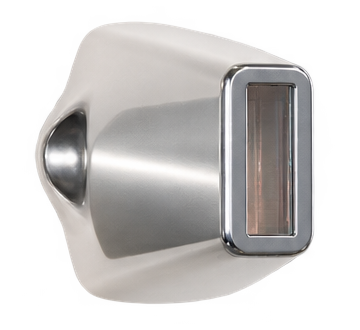
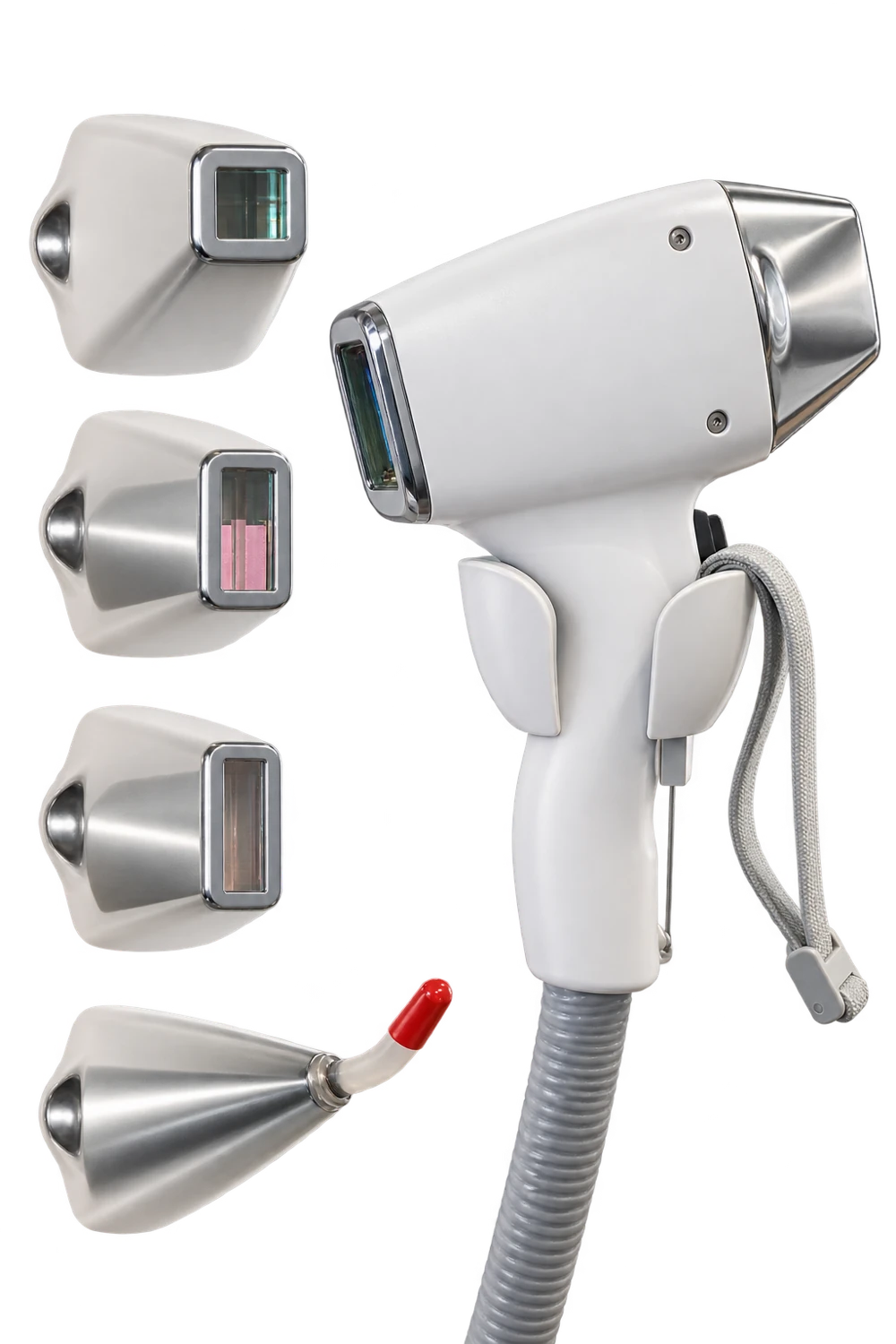
The device’s performance depends on how it works together with a well-designed handpiece. For the ATWX 2400, the specialist manual describes a handpiece with an integrated display and four interchangeable tips: 12 × 34 mm, 12 × 25 mm, 12 × 12 mm and 6 mm.
Different spot sizes allow for different coverage areas. A small attachment and a large rectangular area have different practical uses. The choice of head depends on the intended application, the area and the manufacturer’s instructions.
The click system makes it easier to change the heads. Before use, however, check that the attachment is straight, fully clicked into place and flush with the handpiece. A practical detail such as the locking mechanism is part of using the device and should be covered in the training.
Contact cooling helps control the temperature at the skin’s surface and can affect the sensation of heat. However, it does not make the treatment automatically safe. Appropriate energy delivery, correct handling and ongoing assessment of the skin remain necessary.
The AI support described should also be understood as support for selecting parameters. A system recommendation must be checked by a qualified user. Responsibility for the professional assessment remains with the human.
7. stamping and gliding techniques: different approaches
The specialist manual distinguishes between spot application and treatment in motion. With the Stamping method the handpiece is positioned on a defined area; the pulses are delivered according to the selected mode. When Gliding technique the handpiece is moved across the area while pulses are repeatedly emitted.
The procedures differ in how they are carried out in practice and in the area they cover. Each must be used with the equipment settings and application instructions intended for it. One technique therefore cannot be replaced simply by using a different hand movement.
The choice of method can help when working on small or larger areas. However, it does not remove the limits of light absorption. For example, a stamping method does not automatically make a low-pigment hair a suitable treatment target.
A clear organisation of treatment areas, observation of the skin and regular check-ins about how it feels are all part of professional treatment. The practical application is taught using the specific device.
8. consultation and individual planning
The first step in a professional laser treatment is a conversation. Which area is to be treated? What has been tried so far? What is the hair growth like? Are there any changes or sensitivities? And what result does the client expect?
A structured assessment includes skin and hair profile, current tan, products used, medication and other relevant details. Possible reasons not to proceed with treatment are checked in advance. If findings or risks are unclear, professional or medical assessment is advisable before deciding on the next step.
The explanation should be easy to understand. It covers the planned procedure, possible sensations, realistic results, the likely number of appointments required and possible adverse reactions. An informed discussion leads to a clear decision, with room for questions.
A test area may form part of the planning, in accordance with the device and application instructions. It helps observe an initial reaction, but does not replace a full suitability assessment or guarantee an uncomplicated course thereafter.
Documentation is also part of quality: the treatment area, device configuration, settings used, skin reaction and progress should be recorded in a traceable way. This allows the next appointment to build on the actual course to date.
9. Preparation, treatment and aftercare go hand in hand
Before the appointment
Preparation is intended to create suitable conditions for the treatment. Any recent tanning or irritated skin must be discussed in advance. Products and residue on the treatment area are taken into account during planning and preparation.
Between appointments, hair should not be removed at the root independently if this would remove the intended target structure. Shaving is different. Whether and when to shave depends on the individual instructions of the treating business.
Medications should be disclosed and should not be stopped independently for an appointment. Any changes since the consultation should be discussed again before each session.
During treatment
Suitable eye protection, a prepared working environment, hygienic contact surfaces and controlled operation of the device are part of the procedure. Eye protection must be suitable for the wavelengths actually used and the characteristics of the device. Simply closing your eyes is not sufficient.
The practitioner observes the skin and asks how it feels. Any unusual reactions are not simply disregarded just because a preset procedure has not yet finished. After the application, the treated areas are checked and guidance for the period ahead is discussed.
After the appointment
Aftercare is tailored to the skin’s response, the area and the treatment. This includes protection from additional sun exposure, appropriate gentle skincare and temporarily avoiding friction, intense heat or irritating treatments, in accordance with the individual instructions.
Temporary redness or a feeling of warmth may occur. Worsening symptoms, blisters or marked unexpected skin changes should be reported promptly and assessed by a doctor. This is another reason why having a clear point of contact after the appointment is an important part of good care.
10. Qualifications and equipment care: the foundation of good practice
To independently carry out cosmetic laser hair removal in Switzerland as a beauty professional, the relevant certificate of competence is required. The FOPH lists the certificate of competence «Hair removal with laser» for this purpose. In addition, the person must be familiar with the specific device and its approved use.
A personal device introduction combines general knowledge with hands-on operation: handpiece, attachments, displays, safety features and practical procedures. It complements the required qualification and the manufacturer's documentation.
Regular visual inspections, cleaning in accordance with the manufacturer's instructions and documented maintenance help support reliable operation. Ventilation, cooling circuits, connections and contact surfaces are not minor details. Repairs and work inside the device must be carried out by authorised professionals.
For a business, it is worth clearly defining responsibilities: Who checks the device before use? Who documents maintenance? What is the procedure when an error message appears? A reliable routine provides clarity and makes day-to-day studio operations easier.
11. Creating realistic results builds trust
Hair reduction may lead to a long-term decrease in the number, density and visibility of regrowing hairs. The extent of this change depends, among other things, on hair colour, hair thickness, body area, growth cycle and individual factors.
The term “permanent” should therefore be explained carefully. A long-term reduction in hair growth does not mean guaranteed complete hairlessness for the rest of your life. Further treatments may be necessary later.
Nor can the same number of sessions or the same pace be promised for everyone. Credible advice explains possibilities and limitations. This makes the technology easier to understand and planning more transparent.
A professional result starts with the right choice, clear advice and a structured process. Device technology, expertise and personal support work together.
Frequently asked questions
Can a more powerful laser treat every hair?
Performance alone is not decisive. Light absorption requires a suitable pigmented target structure. Very light, white, grey or certain red hairs therefore remain a limitation that should be discussed in advance.
Is regrowth after the first appointment a sign of failure?
Not automatically. Follicles are at different stages of growth. A series of treatments is also intended to reach hairs that may be in a favourable condition at a later appointment.
Can I use a table to find the right setting for each person?
A table can explain terms and relationships. However, the specific setting must be tailored to the device, the intended application and the individual assessment.
Do cooling and AI replace the practitioner's experience?
Both can support the treatment. Assessing suitability, evaluating the suggestions and monitoring the skin remain the responsibility of qualified practitioners.
Discover the technology. Deepen your knowledge.
Would you like to learn more about the device concept or deepen your existing knowledge in practice? Discover the ATWX 2400, compare our systems in the Laser overview or find out more about the Device training at the AweneX Academy. We’ll discuss your questions with you personally.
Background and further information
Editorial basis: AweneX specialist guide, “Permanent Hair Removal with Diode Lasers – Treatment Practice and Device Description, 2400 W / 3 Wavelengths”. This article prepares the content for the journal and adds general information on qualifications and professional context.
- FOPH: Certificates of competence for cosmetic treatments
- FOPH: Information on cosmetic laser and IPL treatments
- American Academy of Dermatology: Preparing for laser hair removal
- Mayo Clinic: fundamentals and realistic results
Editorial status: 12 October 2026. For binding device specifications and the applicable conformity status, please refer to the current product documentation.